
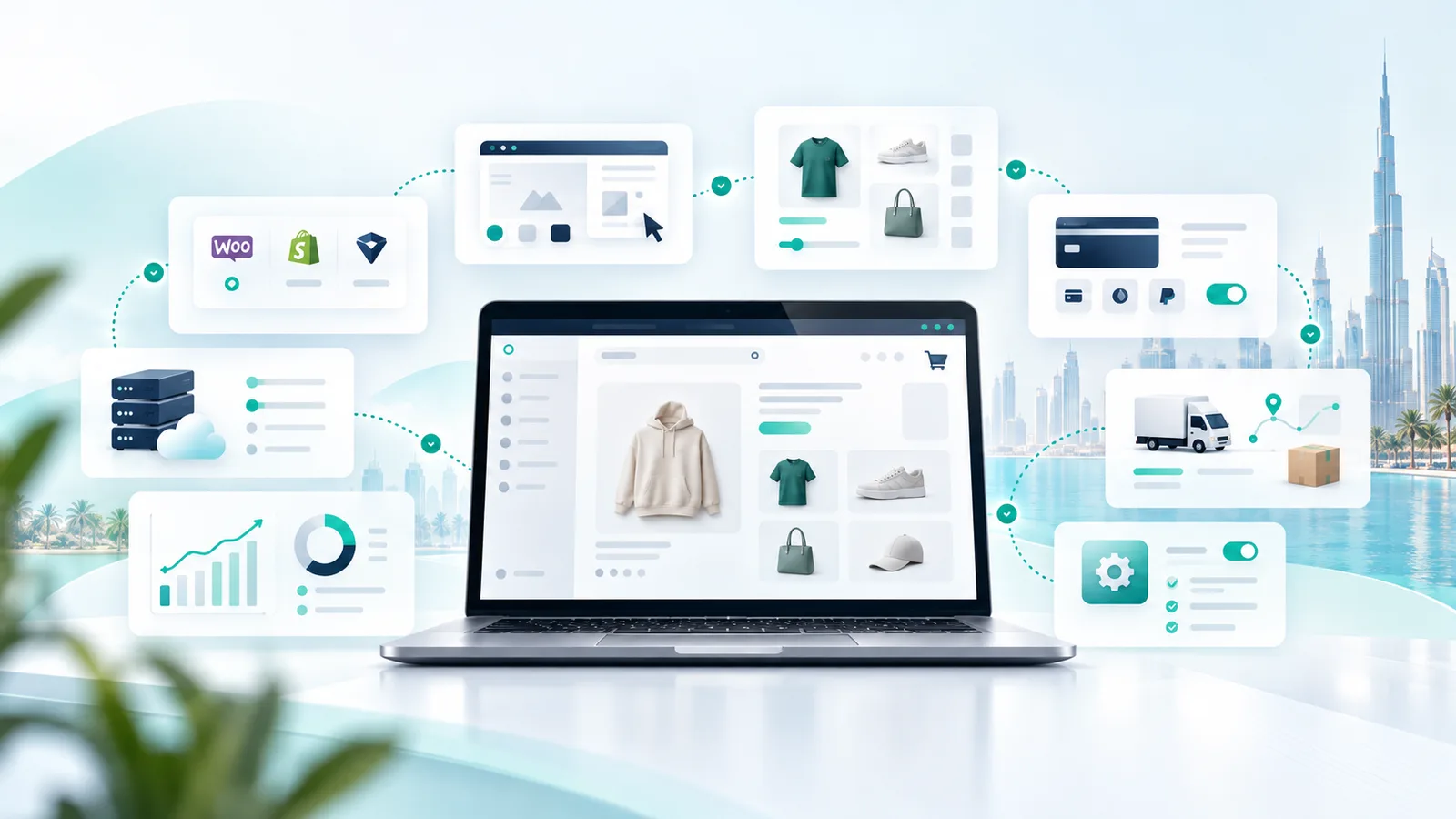
There is no useful single price for an ecommerce website in the UAE until the scope is defined.
A simple launch store, a custom-designed store, and an ecommerce platform connected to business systems are different projects, even though someone might call all three "an online store." The price follows what's actually being built, not the phrase used to describe it.
What actually changes the price
Before any number means anything, these are the factors that actually move it:
- Platform choice — WooCommerce, Shopify, or a custom-built system each carry a different cost structure.
- Template vs. custom design — a themed store and a custom-designed storefront are different amounts of design and development work.
- Number and complexity of products/variations — a 15-product catalog and a 1,500-SKU catalog with size/color variations are not the same build.
- Product-data preparation — whether product photos, descriptions, and pricing already exist, or need to be created and entered.
- Arabic, bilingual, or RTL requirements — depending on the platform and design, these can add scope across layout, content, checkout, emails, and testing.
- Payment requirements — how many gateways, which countries, and any non-standard payment logic.
- Shipping and delivery rules — flat rates are simple; zone-based, weight-based, or courier-integrated rules are not.
- Custom checkout requirements — anything beyond WooCommerce's or the platform's default checkout flow.
- Third-party integrations — email marketing, WhatsApp, live chat, review platforms, and similar tools.
- ERP, CRM, or POS connections — syncing inventory, orders, or customers with systems the business already runs.
- Migration from an existing store — moving products, customers, and order history from a previous platform.
- URL and SEO migration — preserving search rankings and setting up redirects during a platform change.
- Analytics and advertising tracking — ecommerce-accurate GA4, conversion tracking, and ad-platform pixels.
- Merchant Center / product feeds — structured product data for Google Shopping and similar channels.
- Custom functionality — subscriptions, B2B pricing, quote requests, or anything outside standard retail checkout.
- Hosting and infrastructure — shared hosting and a properly sized, ecommerce-ready server are different costs.
- Maintenance and post-launch support — an ongoing cost that may sit outside the initial build quote.
What can a fixed-scope starter store cost?
The clearest way to show how scope defines price is with a real, fixed offer — not a market estimate.
Emargy's own $599 store launch package is a first-party example of what a fixed-scope starter store actually looks like, priced as a single package rather than a custom quote:
What it includes, as published on the offer page:
- A responsive design built on WordPress and WooCommerce, with a homepage and core store pages
- Product and category setup, cart, and checkout — for up to 15 products
- Basic shipping and tax setup
- Stripe or a suitable payment gateway for the business's country, set up and tested
- Order notifications and a full test order/payment before launch
- Domain and SSL for the first year, and hosting for the first year
- Google Merchant Center setup, plus Analytics and Search Console
- Three Emargy WooCommerce products (GEO, Flows, StoreKit) included free for the first year, with renewal after year one optional and priced separately
- 30 days of post-launch support covering implementation bug fixes and stabilizing the included setup
What's explicitly outside the price, per the same page:
- Payment gateway processing fees and commissions
- Renewal of domain, hosting, and the bundled extensions after year one
- Paid external services
- Photography and content writing from scratch
- Custom programming outside the defined scope
Who this fits: a business launching a new store from zero, with a catalog at or under the package's product limit, that doesn't need a custom design, ERP/CRM integration, or non-standard checkout logic. The offer page itself is explicit about this boundary: it's for launching a new store, not for fixing or improving an existing WooCommerce store — that's a different, ongoing scope covered by Emargy's WooCommerce & Ecommerce Systems service instead.
When does ecommerce become a custom development project?
A project moves out of fixed-package territory and into custom scope when it includes things like:
- Custom workflows specific to how the business actually operates
- A complex catalog — large product counts, many variations, or configurable products
- Migrating from an existing store or platform
- Arabic/RTL storefront and checkout requirements
- Connecting to an ERP, CRM, or POS system
- Unusual checkout or payment logic — split payments, approval workflows, custom pricing rules
- Subscriptions, B2B pricing, or account-based ordering
- Advanced third-party integrations beyond standard plugins
- Custom UI/UX beyond a theme's default design
- Operational automation — order routing, custom notifications, or internal tooling tied to the store
None of these are wrong to want — they're simply a different kind of project than a fixed-scope launch package, and pricing them honestly means scoping them first. For a store that needs any of the above, Emargy's UAE ecommerce development approach starts from the actual requirements rather than a fixed catalog limit.
Why two ecommerce quotes can be completely different
Two quotes for "an ecommerce website" can land far apart in price without either one being wrong — because the final number depends on what's actually priced inside it. A quote can include or exclude:
- Design (templated vs. custom)
- Product data entry
- Migration from an existing platform
- Third-party integrations
- Analytics and tracking setup
- SEO/URL migration
- Testing
- Post-launch support
- Hosting and infrastructure
Comparing two final numbers without knowing what's inside each one isn't a useful comparison — it's comparing two different, unlabeled boxes.
What to ask when comparing ecommerce quotes
- Is the design custom or theme-based?
- Who enters or migrates the products — the agency or the business?
- Are payment and shipping integrations included, or scoped separately?
- Is Arabic/RTL included, if the store needs it?
- Is ecommerce-accurate analytics and conversion tracking included?
- Are redirects and SEO migration included, if moving from an existing store?
- Who owns the code, hosting accounts, and licenses after launch?
- What happens after launch — is there any support period, and what does it cover?
- What is explicitly outside the scope of this quote?
Asking these before comparing numbers is useful whether or not the answer leads to working with any specific agency — it's what turns "which quote is cheaper" into "which quote actually covers what I need."
Platform costs
Three broad paths, without turning this into a platform comparison article:
WooCommerce — WooCommerce itself is free and open-source; it's a plugin for WordPress, not a paid platform. The real cost comes from hosting, development time, any paid extensions the specific store needs, and the payment processing fees charged by whichever gateway is used — not a license fee for WooCommerce itself.
Shopify — a hosted, paid platform with tiered monthly plans and its own app ecosystem for extending functionality; the ongoing cost includes the monthly plan plus any paid apps the store needs. Current plan pricing isn't quoted here — check Shopify's own pricing page at the time of reading rather than a figure repeated from an article.
Custom ecommerce — the cost is driven primarily by bespoke development, infrastructure, integrations, and any third-party services the system depends on, rather than by a standard packaged-platform plan.
None of the three is categorically cheaper or faster — which one costs less depends entirely on the scope factors above, not the platform name alone.
UAE-specific scope factors
A few things worth confirming are actually in scope, specifically for a UAE store:
- AED as the store currency, with pricing and totals displaying correctly throughout checkout
- Arabic/RTL, if the store needs a bilingual or right-to-left storefront and checkout
- Payment integrations relevant to the UAE and GCC — which gateway(s) the store needs configured, and for which countries
- Shipping and delivery configuration that matches how the business actually ships — local courier, in-house delivery, or a mix
- VAT display configuration — this is an implementation and configuration point, not tax advice; the store's own accountant or tax advisor should confirm the correct VAT treatment, and the build should simply implement that correctly
- GCC expansion, if the store needs to be structured so that adding another GCC market later doesn't mean rebuilding
None of these change whether a store can be built — they change how much of the scope list above applies.
Need a scope before you need a price?
Share the products, current setup, integrations, and launch requirements. We'll identify whether the project fits a fixed-scope store or needs a custom ecommerce build.
Discuss a UAE Ecommerce Project →
References
- WooCommerce official pricing / open-source documentation (woocommerce.com)
- Shopify UAE official pricing page (shopify.com)