Structure & content
Plan pages, navigation, content hierarchy, and calls to action around what visitors need to understand and do.
Web Development
A business website should explain the offer, earn trust, help people take the next step, and give the team a platform they can actually maintain. We define what the site needs to accomplish first, then design and build around that.

One integrated team
Strategy · Design · Engineering
Since
2006
Delivery
Senior-led
Core stack
Laravel + WP
Handover
You own it
What we build
Design matters, but the experience also depends on content, performance, search visibility, integrations, measurement, and what happens after launch.
Plan pages, navigation, content hierarchy, and calls to action around what visitors need to understand and do.
Design responsive interfaces around the brand and user journey instead of forcing the project into a generic template.
Give the team a practical way to publish and update the content they actually own.
Build for fast loading, mobile usability, accessibility, and sensible Core Web Vitals from the start.
Structure headings, metadata, internal links, schema, crawl behavior, and content so search engines and AI-driven discovery systems can understand the site.
Connect forms, CRM, analytics, payments, booking tools, newsletters, APIs, or other services when the website needs them.
Track the actions that matter—forms, calls, downloads, bookings, or other meaningful website outcomes.
For portals, dashboards, and business systems built around your own workflow, see Laravel Development.
Selected product engineering
Real systems designed, engineered, and operated by Emargy—not decorative concepts.

Our filter
Will this still be clear, fast, and maintainable a year from now?
How quality shows up
A clearer explanation of the business and the next action for each visitor.
A structure that can grow without turning navigation and content into a maze.
Responsive, accessible, performance-conscious pages from the start.
A practical editing workflow for the team after launch.
Integrations and measurement that connect the website to the rest of the business.
A visible process
Decisions stay visible, progress stays reviewable, and risk is handled before it becomes expensive.
Business goals, audiences, content, existing systems, and what the website needs to accomplish.
Plan information architecture, journeys, content model, integrations, and measurement.
Create the interface and responsive experience around the content and brand.
Develop, integrate, test performance, mobile behavior, accessibility, forms, and key journeys.
Deploy with analytics and technical checks in place, then improve based on real use.
Client work
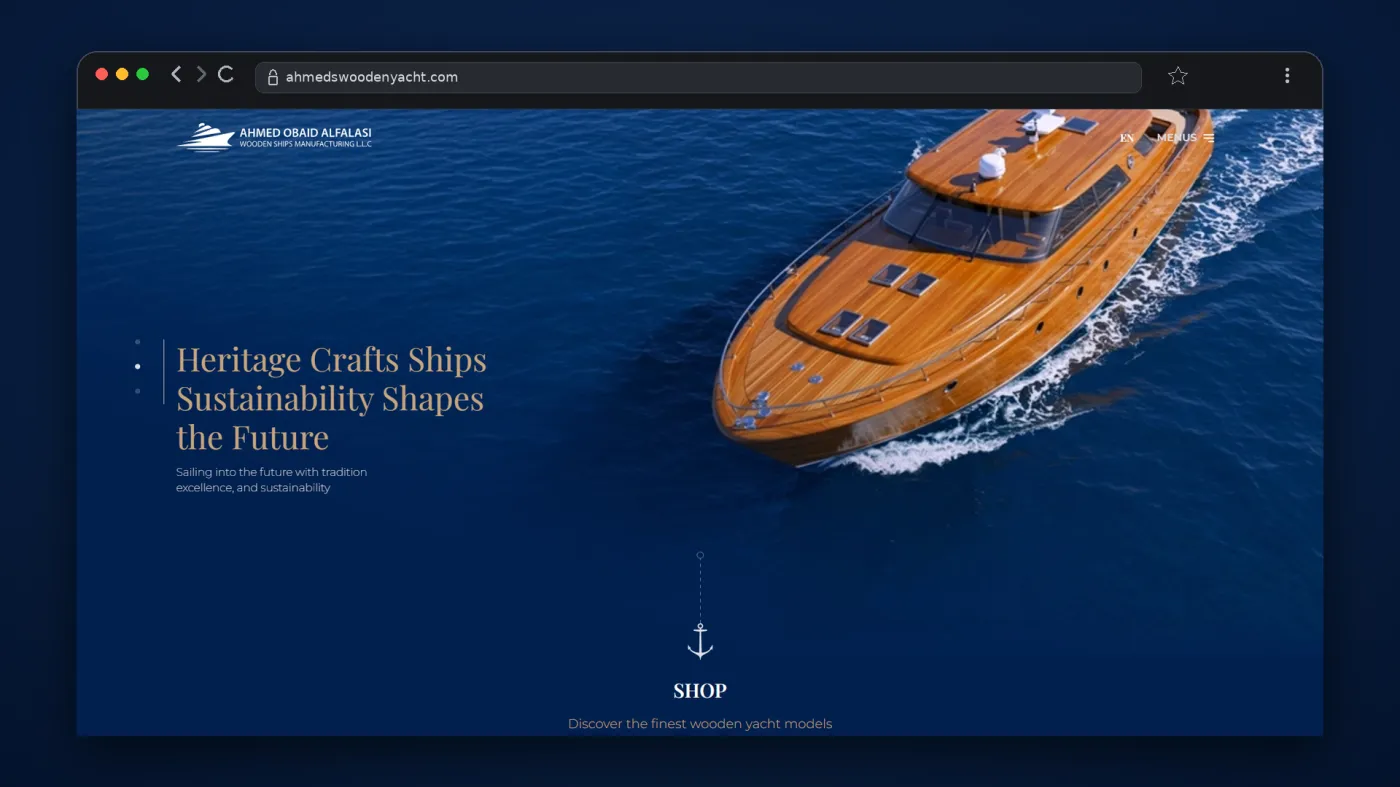
Ahmed Obaid Alfalasi Wooden Ships Manufacturing L.L.C. · 2025
Web Design & Development
A custom Arabic and English website presenting maritime craftsmanship and yacht models, with direct enquiry paths, domain setup, and managed hosting.

Rani Nights · 2026
Web Design & Development
A bilingual service website with Arabic RTL layouts, a responsive experience, and direct WhatsApp contact paths.
Technology choice
The technology should fit the content model, editing workflow, integrations, complexity, performance requirements, and long-term ownership.
Useful when editorial flexibility, established CMS workflows, and a broad ecosystem fit the website.
Useful when the website needs custom application logic, deeper integrations, permissions, or functionality beyond a conventional CMS.
Some websites do not need a heavy platform at all. When the requirements are simple, the architecture should stay simple too.
We choose the stack after the requirements—not before them.
Common questions
Yes. We can handle both UX/interface design and development as one project when that is the right scope.
We can work with an existing system when appropriate, but custom projects are designed around the actual requirements instead of forcing the business into a generic prebuilt layout.
It depends on the content, workflows, integrations, custom logic, and how the site needs to be maintained. We choose after understanding those requirements.
Yes. We first determine whether the current site should be improved, partially rebuilt, or replaced.
Your proposal defines the pages, languages, design, development, content management, integrations, testing, launch, and handover included in your project. It also explains what we need from you and identifies separate items such as copywriting, translation, hosting, third-party subscriptions, and maintenance, so the scope and costs are clear before work begins.
The main factors are the number of distinct page layouts, languages, content readiness, custom functionality, integrations, and migration requirements. Your proposal defines the deliverables, review stages, third-party costs, and schedule before development begins.
Yes. We plan Arabic right-to-left and English left-to-right experiences, including navigation, mobile layouts, content management, and search configuration for both languages. Ahmed’s Wooden Yacht and Rani Nights are published examples of our bilingual work. Translation and copywriting responsibilities are defined in the proposal.
An AI website builder may be sufficient for a simple site you can review and maintain yourself. Emargy is relevant when you need content and customer journey planning, Arabic and English experiences, business integrations, testing of important interactions, and an agreed launch and handover. We assess your requirements before recommending the build approach.
Technical foundations such as structure, metadata, crawlability, internal linking, performance, schema, and analytics are considered during the build. Ongoing search strategy and content work can continue under Search & Growth.
Yes, when ongoing support or maintenance is included in the agreed scope.
Have a serious web project?
A new site, an old site that has stopped keeping up, or a project that needs more than a template—show us the goal and what is getting in the way.
We reply within one business day